
EXECUTIVE SUMMARY
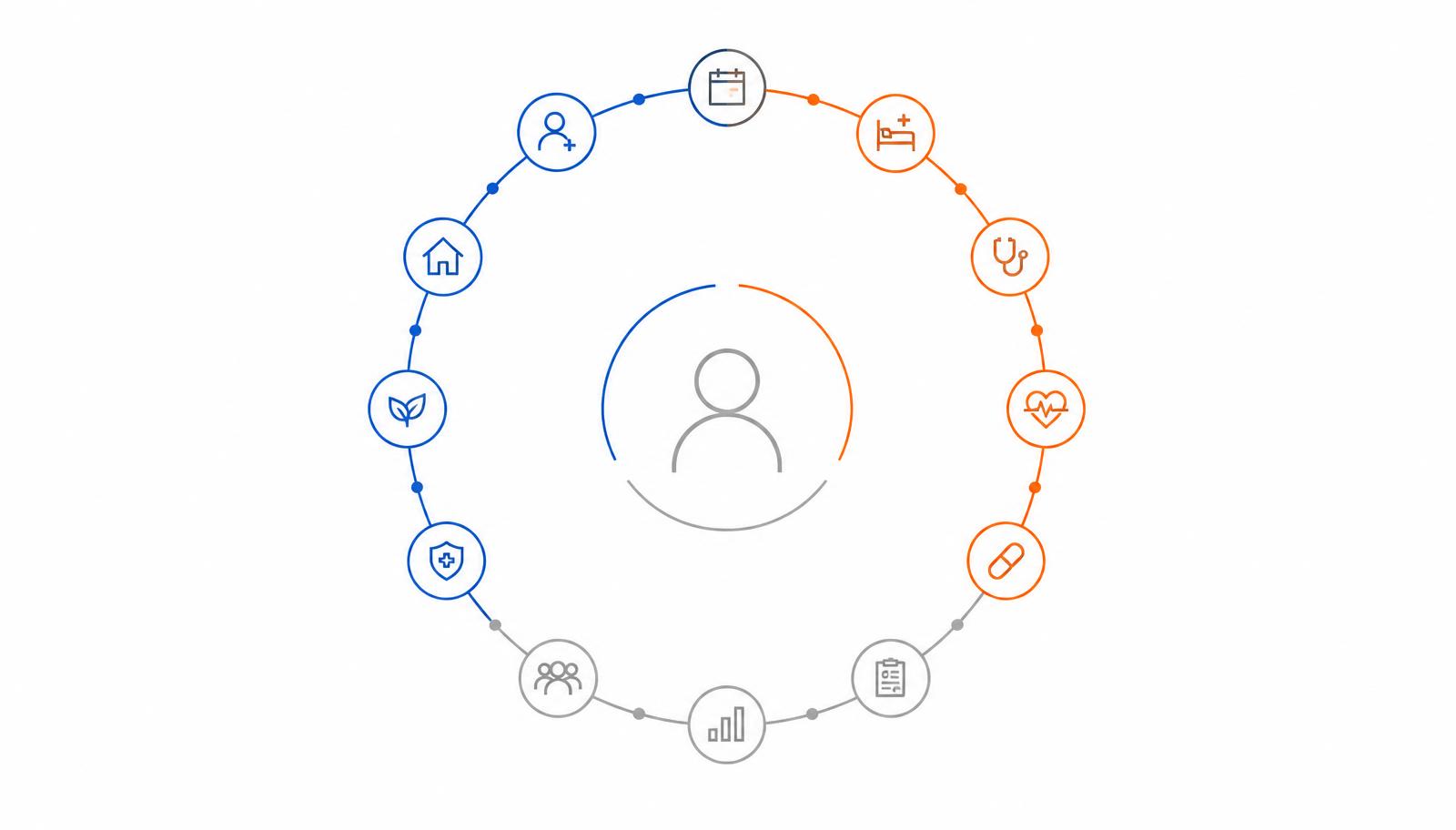
- Four agents prepare patients before care through onboarding, approved guidance, access navigation and attendance support.
- Four agents make care more understandable through status, waiting, family updates and clear explanations.
- Four agents support recovery and follow up while institutional protocols and human clinical judgment remain in control.
Healthcare has digitized many of its systems, but the patient experience is still remarkably fragmented. Scheduling lives in one system, clinical records in another, insurance authorization somewhere else, while communication is split across email, WhatsApp, apps, call centers and paper instructions. In Brazil, medical health plans cover more than 53 million beneficiary records, approximately 25% of the population. [1] The opportunity for 2027 is not simply to add another digital channel. It is to orchestrate the entire experience through a coordinated set of intelligent agents.
A foundational Bain & Company and Anahp study involving nearly 14,000 patients across 18 Brazilian private hospitals provides a useful starting point. Clinical quality and healthcare professionals were major drivers of promotion, while waiting time was the leading driver of detraction. The study also found that patients highly valued explanations about procedures, next steps and post hospital instructions. [2] Although the research was conducted in 2016 and should not be interpreted as a current national benchmark, the underlying friction points remain highly relevant: access, uncertainty, administrative effort, communication and continuity.
Before Care: turn information into engagement
The first four LISA agents operate before the patient arrives. LISA Smart Onboarding converts long, static instructions into short videos, personalized messages and progressive content. LISA Preparation Agent answers contextual questions using preparation content approved by the healthcare institution. LISA Access Navigator monitors authorization, documentation, location and readiness. LISA No Show Prevention identifies patients at risk of missing an appointment and activates the appropriate reminder, confirmation or rescheduling flow.
This is more than convenience. A systematic review of digital appointment notifications found that patients receiving electronic reminders were 23% more likely to attend and 25% less likely to miss an appointment than those receiving no notification. [3] More recent reviews continue to find evidence that reminders reduce non attendance, while predictive models combined with patient navigation have produced larger effects in some settings. The opportunity for LISA is to move beyond the generic ‘Your appointment is tomorrow’ message. The system can understand who the patient is, what procedure is scheduled, which institution approved instructions matter and what action should happen next.
During Care: make an invisible process visible
Four additional agents operate while care is happening. LISA Waiting Companion manages expectations around delays and estimated waiting times. LISA Care Status tells patients where they are in the process and what comes next. LISA Family Updates keeps authorized relatives informed during selected procedures or hospital stays. LISA Care Explainer translates complex operational and care information into language the patient can understand.
This matters because uncertainty magnifies waiting. In the Bain and Anahp study, patients perceived waiting and administrative processes as barriers between themselves and access to healthcare. The emergency department was particularly sensitive. Patients who combined emergency care with outpatient, inpatient or diagnostic services reported NPS scores between 19 and 24 points lower than comparable patients who did not use the emergency department. [2] The future opportunity is therefore not only queue reduction. It is uncertainty reduction.
Imagine a patient receiving: ‘Your registration is complete. You are now waiting for imaging. Current estimated time: 18 minutes. We will notify you when the room is ready.’ That interaction does not add another clinical professional, another machine or another bed. It simply makes the existing care system understandable.
After Care: from discharge to continuous recovery
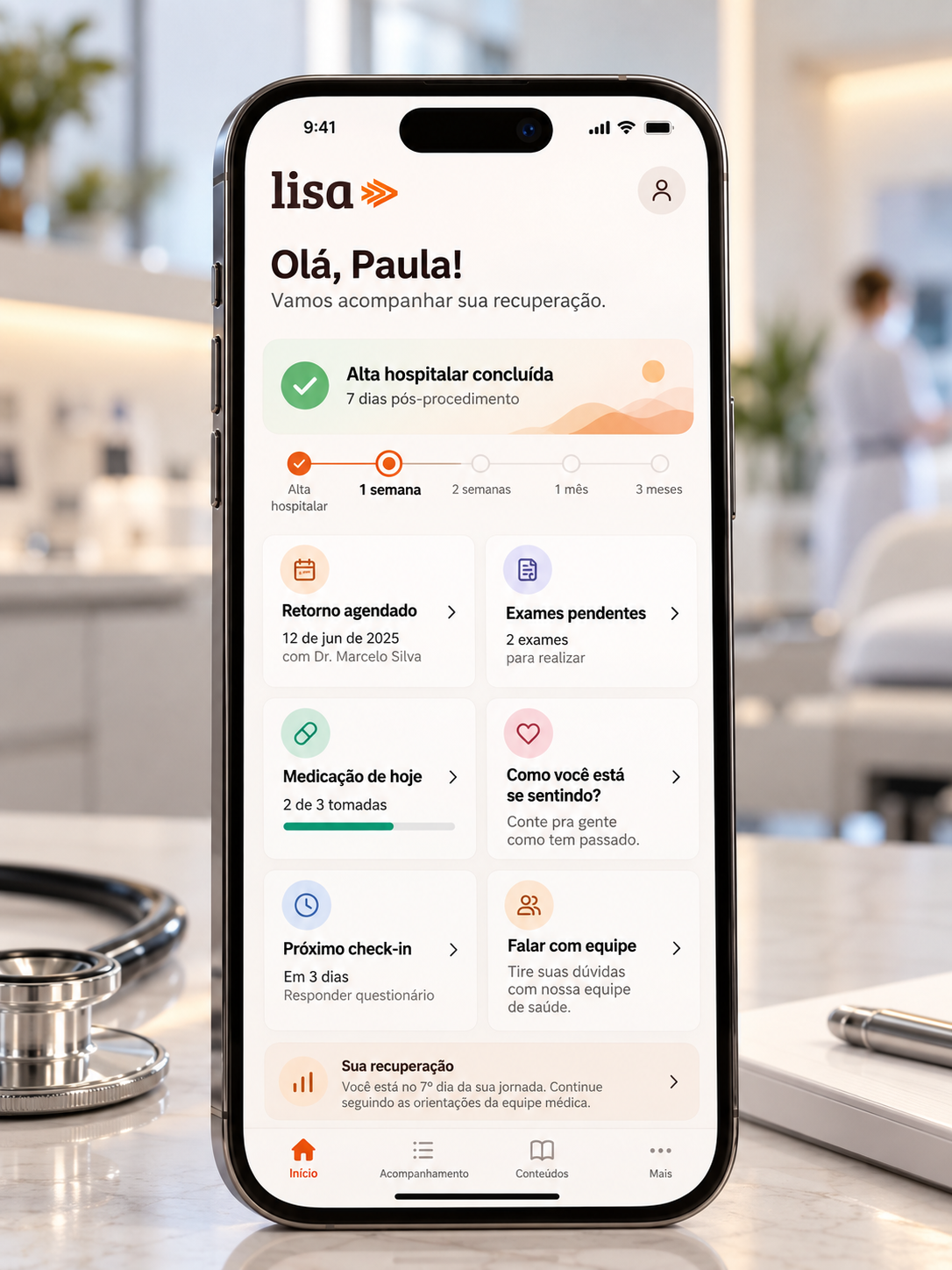
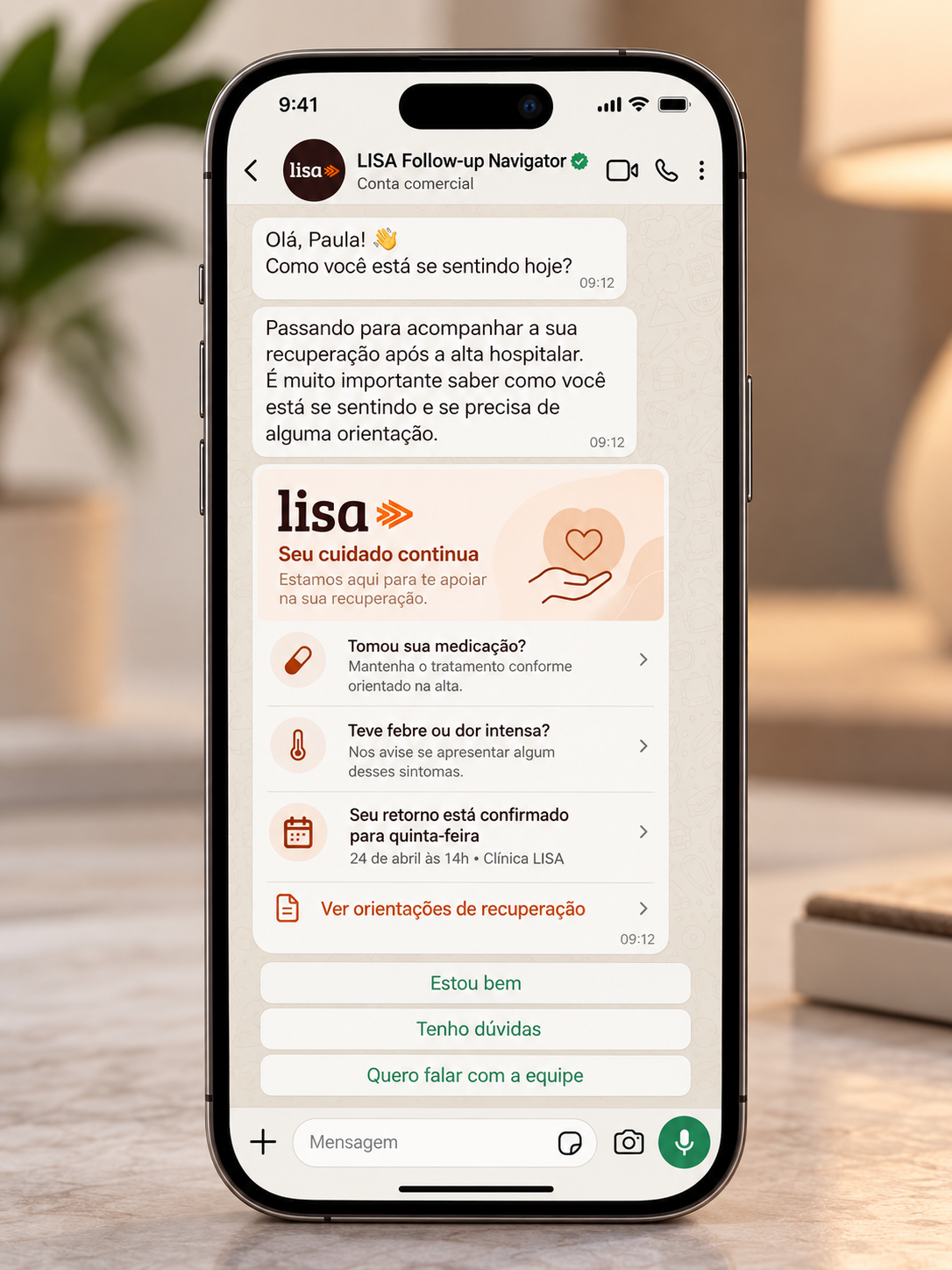
The final four agents extend the relationship beyond the hospital walls. LISA Recovery Agent maintains contextual conversations after discharge. LISA Medication Companion reinforces medication routines and identifies adherence difficulties. LISA Red Flag Detection recognizes patient reported warning signals and escalates them according to protocols defined by the healthcare organization. LISA Follow Up Navigator coordinates return visits, examinations and unfinished next steps.
This is where conversational technology may create some of the greatest clinical and economic value. The Brazilian hospital study found that medication instructions and post hospital follow up were important contributors to positive patient experience. [2] International evidence also points in the same direction. A 2025 meta analysis of 34 randomized trials involving 5,191 patients after percutaneous coronary intervention found that transitional care interventions were associated with an approximately 32% reduction in readmission risk compared with standard care. [4] Digital adherence technologies also show measurable potential. A 2024 meta analysis of technology based interventions in tuberculosis care reported improved treatment adherence and treatment success, while results varied by technology and setting. [5]
GALLERY 1 / 2
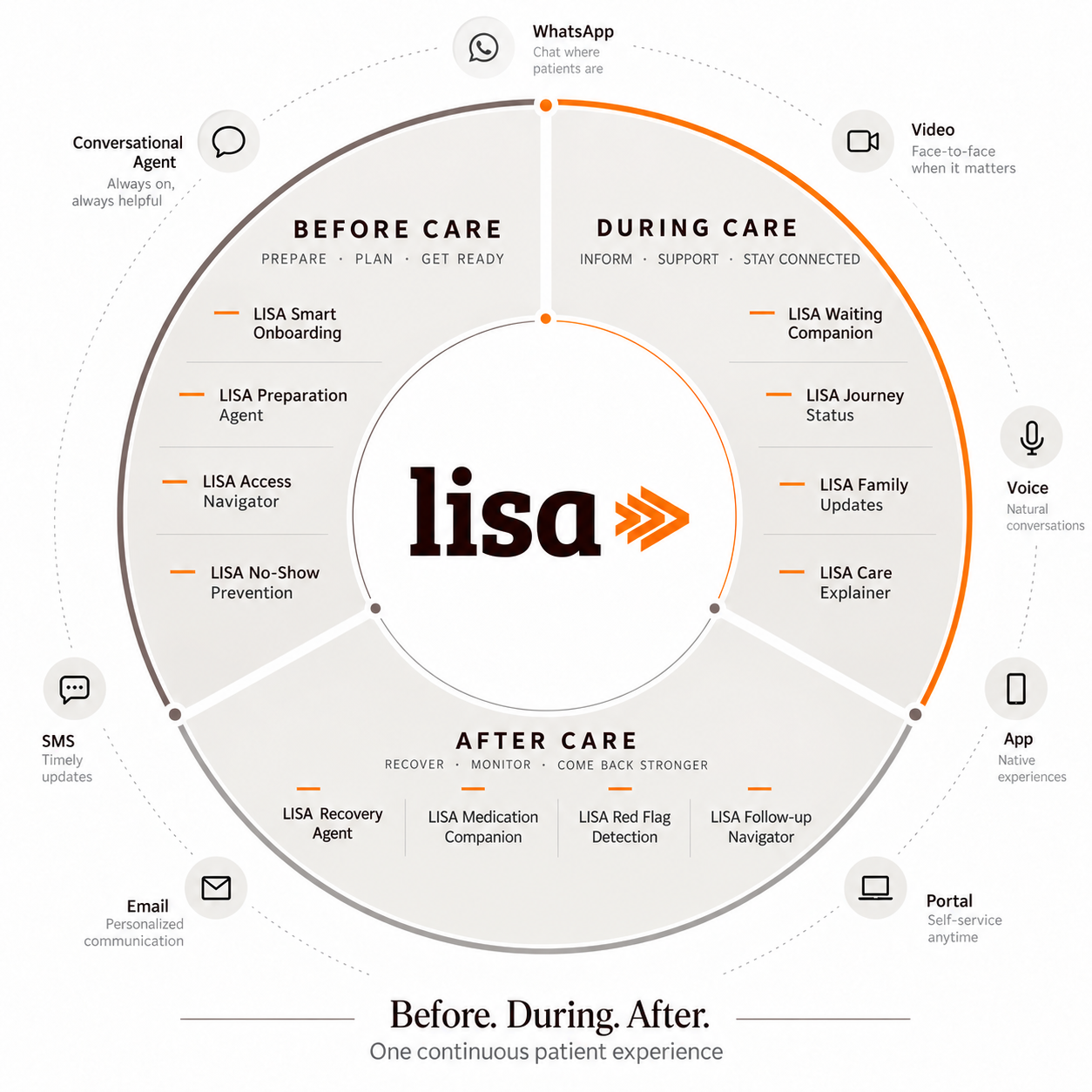
The 12 agents should behave like one system
The real technical advantage is not having twelve separate chatbots.
It is having twelve specialized capabilities operating on one longitudinal patient context.
At the center of the LISA operating model are four questions:
- Who is this patient?
- What is the current clinical and operational context?
- Where is the patient in the care process?
- What is the next best action?
Every new event changes the state of the care process. An appointment is confirmed. An authorization is approved. A procedure ends. A discharge occurs. A patient reports worsening pain. The orchestration layer interprets the event and determines which agent, channel and human team should act.
The patient does not need to know which agent is operating. From their perspective, there should be one continuous relationship.
AI should know when to stop
The most important design principle is also the most important safety principle.
LISA should not position conversational agents as autonomous clinical decision makers.
- Information, which can often be automated
- Navigation, which can often be orchestrated
- Monitoring, which can be supported by algorithms
- Clinical judgment, which remains with qualified healthcare professionals
For example, Red Flag Detection should not diagnose a complication. It should identify that a patient response matches an escalation rule established by the institution and connect the patient to the appropriate clinical pathway.
That distinction is essential for trust, governance and responsible adoption.
From digital channels to a digital care relationship
The healthcare industry has spent years adding channels: apps, portals, WhatsApp, call centers, emails, SMS and telemedicine.
The next phase is different.
The opportunity is no longer to digitize each touchpoint. It is to connect the touchpoints into one intelligent care experience.
That is the proposition behind the twelve LISA agents.
SOURCES
- 01ANS beneficiary data · Agência Nacional de Saúde Suplementar · September 04, 2026
- 02Patient satisfaction in Brazilian private hospitals · Bain & Company and Anahp · May 09, 2017
- 03Digital appointment notifications · BMJ Open · October 01, 2016
- 04Transitional care after PCI · Studies in Health Technology and Informatics · August 07, 2025
- 05Technology based adherence interventions · PLOS One · December 02, 2024
Get healthcare intelligence briefings
New technical analyses as they are published, no noise.
INSIGHTS
Get LISA's next analyses
New readings and each closed edition, sent as they are published.
RELATED READINGS

Strategy
Designing for Attendance: How Behavioral Economics Can Reduce No Shows in Healthcare
Missed appointments are rarely caused by forgetfulness alone. Behavioral design can help healthcare organizations identify friction and support attendance at the right moment.
Sep 26, 2026 · 9 min read

Strategy
Patient Experience in Brazil: Two Opportunities for 2027
Onboarding as engagement and intelligent post-discharge conversations: two practical opportunities for Brazilian healthcare in 2027.
Sep 26, 2026 · 2 min read

GLP-1 Intelligence
Why cost per milligram fails in the semaglutide market
When the unit shifts from milligram to treatment week, Brazil’s semaglutide market shows a narrow weekly-cost convergence that cost per milligram completely hides.
Aug 08, 2026 · 5 min read