
When does a healthcare AI agent need Anvisa registration?
The answer is not in the technology, but in the product's declared intended purpose. What RDC 657/2022, RDC 751/2022 and Anvisa's official answers say about AI agents.
BY Lisa Intelligence · PUBLISHED November 05, 2026 · 6 min read
UPDATED November 05, 2026
EXECUTIVE SUMMARY
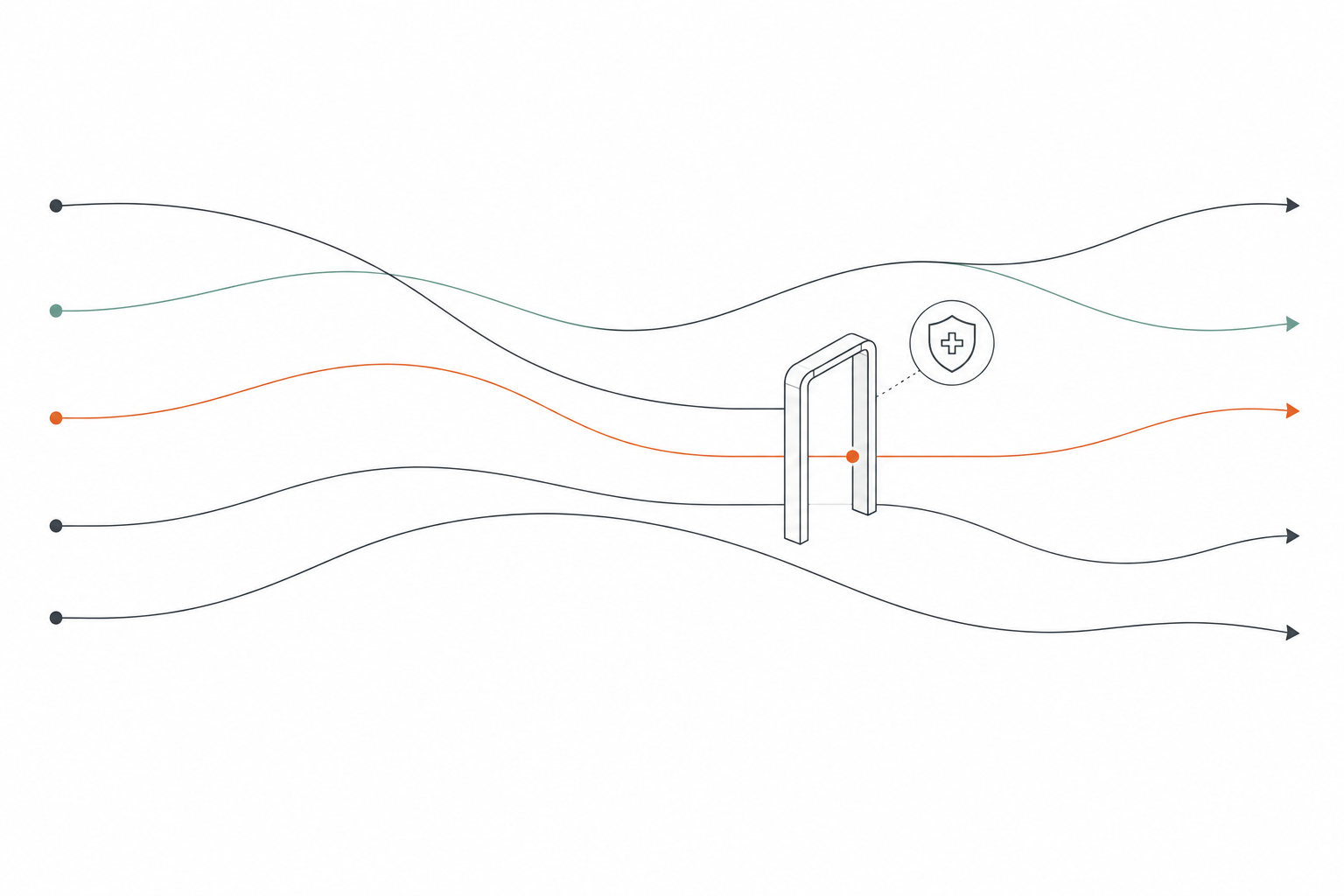
- The dividing line is the declared intended purpose, not the use of AI. An agent can use artificial intelligence and still not be a medical device.
- Agents limited to scheduling, medical records, information logging and communication, including delivering to the patient the prescription written by the physician, do not qualify as software as a medical device (SaMD), according to Anvisa's official answers.
- If the agent provides information used in diagnostic or therapeutic decisions, it is SaMD and falls under class II by Rule 11 of RDC 751/2022, rising to III or IV depending on the impact of a wrong decision.
- Classes I and II go through notification; classes III and IV require registration, with a technical report, risk management and compliance with IEC 62304, IEC 62366-1 and ISO 14971.
- AI supporting a medical purpose requires its own documentation: applied technique, training datasets and learning history. Continuous learning in production is treated as innovative technology.
- The revision of RDC 657/2022, incorporating artificial intelligence and machine learning, is on the preliminary topic list of Anvisa's 2026-2027 Regulatory Agenda.
A healthcare AI agent does not need registration because it uses artificial intelligence. It needs it when the intended purpose declared by the manufacturer turns it into a medical device. This guide shows where Anvisa draws that line: what RDC 657/2022 and RDC 751/2022 say, what the agency has already officially answered about virtual assistants, and what is coming in the 2026-2027 Regulatory Agenda.
The question that decides everything: the declared intended purpose
RDC 657/2022 defines software as a medical device (SaMD) as software that meets the definition of a medical device, "intended for one or more medical indications, and that performs these purposes without being part of medical device hardware" (art. 2, VII). The definition includes mobile apps and subscription-licensed, centrally hosted software.
The same resolution excludes five cases from the framework (art. 1, paragraph 2): wellness software; software on Anvisa's list of unregulated products; software used exclusively for administrative and financial management in healthcare services; software that processes demographic and epidemiological data with no clinical, diagnostic or therapeutic purpose; and software embedded in a medical device already under sanitary surveillance.
The point that matters most for AI agents comes from Anvisa's official Q&A document on RDC 657/2022: "it is not a matter of whether the software uses AI or ML, but rather the intended use of the device that must be observed" (answer 111). Using artificial intelligence does not make a product a medical device; declaring a medical purpose does. The regulatory question is not "does the agent use AI?", but "what does the manufacturer declare it does?".
What Anvisa has already answered about virtual assistants
The Q&A document records real inquiries very close to what we now call an AI agent. In one of them (answer 26), a platform with an app and a virtual assistant, including a chatbot, telehealth and voice interaction with predictive models, was reviewed by Anvisa. The conclusion: limited to scheduling, appointment booking, electronic medical records, logging the patient's condition and communication, the solution does not fall under the rules and is not a medical device subject to regularization.
In answer 9, the same reasoning for telemedicine: software that performs only medical record, scheduling, data transmission and communication functions, by video, audio or text, is not a medical device. Diagnosis and treatment suggestions made by the physician, without the software's help, do not change that framing.
Answer 24 draws the finest line: software that prescribes medication is SaMD; but "if the software only serves to communicate to the patient the prescription made by a physician, in this case the function is communication" and no framing applies. The physician decides the course of action; software that merely carries that decision stays outside the medical device regime.
When the agent becomes a medical device
If the declared intended purpose includes informing clinical decisions, the product is SaMD and its risk classification comes from Rule 11 of Annex I of RDC 751/2022. Software intended to provide information used for diagnostic or therapeutic decision-making is class II; it rises to class III if those decisions could cause serious deterioration of health or surgical intervention, and to class IV if they could cause death or irreversible deterioration. Software monitoring physiological processes is class II, or III when it involves vital parameters with immediate risk. Any other SaMD is class I.
The class defines the regime (arts. 6 and 7 of RDC 751/2022). Classes I and II follow notification: the form goes to Anvisa, but the technical dossier stays with the company (art. 10 of RDC 657/2022). Classes III and IV require registration, with a technical report covering software and hardware architecture, interoperability, cybersecurity controls, verification and validation, risk management and clinical evaluation (art. 12), plus a declaration of conformity with IEC 62304 (software life cycle), IEC 62366-1 (usability) and ISO 14971 (risk management), or equivalent versions (art. 13).
On timelines and entry costs, the Q&A document records: petitions follow the 90-day deadlines of Law 6,360/1976, and RDC 743/2022 set 30 days for notifications. The petitioning company needs an Operating Authorization (AFE) covering the right activity and, under the registration regime, the manufacturer needs Good Manufacturing Practices certification. And a warning often forgotten: distributing SaMD without regularization, even for free, is a sanitary violation.
The AI-specific layer
When AI is used to achieve the product's medical purpose, Anvisa requires a specific report (answers 50 and 111): the rationale justifying the applied technique, the size and description of the datasets used for learning, training and verification, the origin and quantity of the data and the statistical justification for the dataset sizes. Missing information can lead to rejection.
On continuous learning, the recorded position is direct (answer 115): there is no regularized SaMD with open-code AI in continuous learning. Such a product would be treated as innovative technology and would need to demonstrate safety and efficacy, with protection mechanisms against deviations from the validated code. In practice, the code is frozen before submission, and relevant algorithm changes go through an amendment petition (art. 16 of RDC 657/2022).
The regulatory horizon is already visible. The preliminary topic list of the 2026-2027 Regulatory Agenda includes the revision of RDC 657/2022, justified by the need that "items related to artificial intelligence and machine learning must be incorporated into the RDC", along with harmonization with international practices. Until then, the current rule stands: the declared intended purpose governs.
Where Lisa stands
Lisa was designed to operate on the communication side, in the same framing Anvisa has already recognized as outside the medical device regime. Nothing reaches the patient without human approval; the agent does not choose courses of action or treatments; the clinical content is, literally, what the team approved; clinical questions go to the human queue, with the conversation's context. It is the same design described in the technical article on the limits of Lisa's guard rails.
The Lisa ANVISA Ready initiative organizes this regulatory and clinical-safety readiness: if a future purpose requires framing as SaMD, the architecture of frozen versions, explicit approval and traceability already speaks to what RDC 657/2022 asks for in verification, validation and change management.
Checklist before launching a healthcare AI agent
- Write the declared intended purpose of the product, in full, in the scope. It is the document Anvisa reads first.
- Ask whether the agent informs or suggests diagnostic or therapeutic decisions, or only communicates what the physician decided. Only the first case becomes SaMD.
- If it is SaMD, estimate the class by the impact of a wrong decision: death or irreversible harm points to IV; serious deterioration, to III; all other cases, to II.
- Check whether the AI learns in production. If it does, prepare for the innovative-technology regime; if not, freeze and version the code before any submission.
- Confirm the company prerequisites: an Operating Authorization (AFE) covering the right activity and, for registration, Good Manufacturing Practices certification.
- If in doubt, use Anvisa's formal software framing channel before launch, not after.
METHOD
Norms verified against official sources (Diário Oficial da União, gov.br/anvisa and planalto.gov.br) on November 5, 2026. The RDC 657/2022 Q&A document used is version 1, September 2022, the most recent published by Anvisa.
SOURCES
- 01RDC 657/2022 — regulation of software as a medical device · Diário Oficial da União / Anvisa
- 02Q&A on RDC 657/2022 (version 1, Sep/2022) · Anvisa
- 03Classification of devices and software (Rule 11, Annex I of RDC 751/2022) · Anvisa
- 04Q&A on RDC 751/2022 · Anvisa
- 05Law 6,360/1976 — sanitary surveillance · Presidência da República
- 06Regulatory Agenda 2026-2027 — preliminary topic list, medical devices · Anvisa
Get healthcare intelligence briefings
New technical analyses as they are published, no noise.
INSIGHTS
Get LISA's next analyses
New readings and each closed edition, sent as they are published.
HEALTH BRAZIL COMMUNITY
Join a curated community of healthcare leaders.
RELATED READINGS
Strategy
Treatment happens at home. Half of it never does.
The WHO measured it: half of chronic treatments are not followed in developed countries. The plan dies at home, between appointments. Lisa's agents stay with the patient in that interval, with consent and human escalation.
Nov 13, 2026 · 2 min read

Strategy
The regulatory clock is ticking. Who answers the patient on time?
Since July 2025, ANS Normative Resolution 623/2024 has imposed channels, hours and response deadlines on Brazilian health plan operators. Fast service is no longer a quality goal: it is compliance.
Nov 12, 2026 · 1 min read
Strategy
The patient didn't forget. They never understood.
Before memory comes comprehension: nearly 9 in 10 adults struggle with health information. That is where the design of Lisa's agents begins.
Nov 11, 2026 · 2 min read
Strategy
Care is not a disturbance: the consent behind every message
No message from Lisa's agents goes out without a care plan and without the patient's permission. The design behind proactive contact.
Nov 10, 2026 · 2 min read